Turtle Bay, Manhattan Leak Diagnostics
Leak Detection in Turtle Bay, Manhattan
Locating concealed water leaks behind plaster walls, beneath hardwood floors, and above decorative ceilings across Turtle Bay, East Midtown, and Sutton Place. In dense multi-story co-ops, brownstones, and condominium towers, pinpointing the true origin of moisture without tearing open every wall protects valuable interior architecture and preserves neighborly peace of mind.
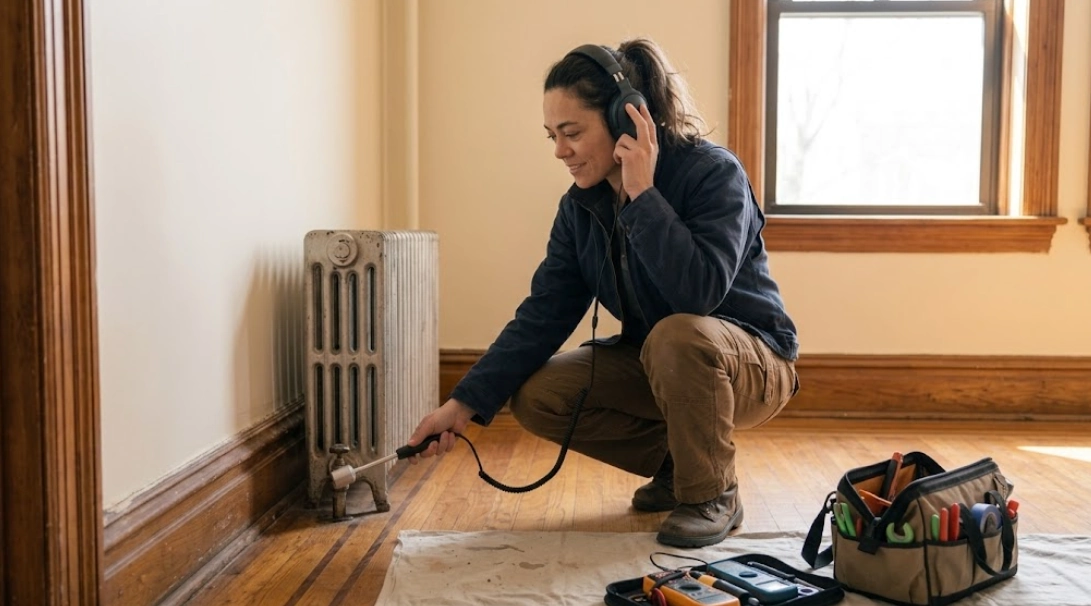
Non-invasive electronic leak detection and moisture mapping in Manhattan apartments
Recognizing the Subtle Signs of a Concealed Water Leak
Water rarely announces its presence with a catastrophic pipe burst. More frequently, a pipe leak in a dense Manhattan residence begins as an invisible seepage inside a concealed plumbing chase. Homeowners, co-op shareholders, and building managers should stay vigilant for these telltale indicators:
Ceiling Discoloration
Faint yellow, brown, or rust-colored rings spreading across living room, hallway, or bathroom ceilings often signal slow vertical drainage or supply seepage from above.
Bubbling Paint & Plaster
When moisture saturates historic lime plaster or modern drywall, paint loses its bond, resulting in blistered, soft, or crumbly wall textures along baseboards.
Damp Floors & Cupping Wood
Hardwood parquet or strip flooring that begins to buckle, warp, or feel spongy underfoot points to water tracking horizontally beneath the subfloor.
Persistent Musty Odors
A damp, earthy smell in closets, under kitchen sinks, or near bathroom vanities indicates trapped moisture encouraging hidden mold proliferation inside enclosed wall cavities.
Unexplained Water Usage
In properties with sub-meters, a water meter dial that creeps forward when all fixtures, valves, and appliances are shut off confirms an active pressurized leak.
Dripping Sounds Behind Walls
Hearing rhythmic ticking or dripping sounds inside structural shafts after a neighboring unit discharges a bathtub or runs a washing machine indicates drainage stack leaks.
Why Accurate Leak Detection Matters in Turtle Bay
Turtle Bay is one of Manhattan's most distinctive residential enclaves, bounded by the East River near the United Nations Headquarters, extending westward toward Grand Central Terminal and Lexington Avenue. The neighborhood encompasses classic late-19th-century brownstones, pre-war elevator co-ops along 48th and 49th Streets, and sleek modern post-war high-rises.
When a leak in wall detection Turtle Bay Manhattan issue arises, the complexity of urban high-density construction multiplies the challenge. Vertical plumbing risers, steam supply lines, branch drains, and domestic hot water loops are tightly bundled inside shared building shafts. A leak that originates on an upper floor can travel dozens of feet laterally across concrete floor slabs before penetrating through a ceiling below.
Addressing persistent overhead water penetration requires professional ceiling leak repair Turtle Bay Manhattan diagnostics, ensuring the true source above is verified and neutralized before drywall or plaster restoration begins. For targeted mechanical line solutions, our team also provides pipe leak repair and full repiping services.
Manhattan Building Realities: Visible water damage on your ceiling or wall is a symptom of water exit, not necessarily the point of pipe rupture. Accurately tracing water paths requires understanding building riser layouts and pressure testing individual branch lines.
Suspecting a Hidden Water Leak in Your Manhattan Residence?
Avoid unnecessary wall demolition. Speak directly with a plumbing professional to discuss diagnostic testing, moisture mapping, and practical repair steps in Turtle Bay.
Call (315) 202-8009 to Schedule
Common Concealed Leak Locations in Manhattan Apartments
During routine apartment leak detection Turtle Bay Manhattan service visits, technicians frequently uncover failures within several vulnerable plumbing junctions:
Bathroom Wet Walls & Shower Pans
Concealed shower diverter valves, tub overflow gaskets, and aged tile shower pan liners frequently permit water to seep behind ceramic tile during daily bathing, gradually rotting structural subfloors.
Shared Building Risers & Branch Tees
Vertical cast-iron soil stacks and galvanized vent risers endure constant thermal expansion. Over decades, threaded branch tees and lead-caulked hub joints can loosen, allowing sewer water or condensation to escape.
Kitchen Sink & Appliance Connections
Vibrating garbage disposals, dishwasher discharge hoses, and under-sink reverse osmosis filtration systems have multiple pressurized mechanical joints that can loosen unnoticed inside cabinetry.
Water Heaters & Heating Risers
In-unit water heaters and hydronic heating loops with corroded fittings or failing pressure relief valves can release fine mists into mechanical closets. If you suspect boiler heating or hot water equipment issues, review our dedicated water heater repair and boiler repair resources.
How a Professional Leak Detection Visit Works
Solving a concealed water problem requires methodical investigation rather than guesswork. When conducting hidden water leak detection Turtle Bay Manhattan calls, technicians follow a structured diagnostic workflow:
-
1
Intake and History Review
We review the moisture timeline: when stains first appeared, whether the dampness is constant or intermittent, and whether symptoms coincide with rainfall, laundry cycles, or upstairs shower usage.
-
2
Visual & Non-Invasive Surface Inspection
Using thermal imaging cameras and electronic moisture meters, we map temperature differentials and moisture concentrations across walls and ceilings without cutting into building materials.
-
3
Acoustic & Pressure Isolation Testing
Where pressurized supply lines are suspected, sensitive acoustic listening equipment detects high-frequency hissing generated by water escaping under pressure through microscopic pipe breaches.
-
4
Fixture & Drainage Isolation
We isolate individual fixtures, test cleanout traps, and inspect branch lines. If slow drains or stack backups are contributing to moisture, review our drain cleaning services.
-
5
Findings Review & Targeted Access Planning
Once the suspected origin is isolated, we explain our findings clearly to the property owner or resident manager. If an exploratory opening is required, it is planned precisely to minimize drywall restoration.
Navigating Apartment & Upstairs-Unit Leaks
Investigating a water leak from upstairs apartment Turtle Bay Manhattan scenario requires diplomatic coordination between shareholders, tenants, building management, and insurance adjusters.
A key engineering fact must be emphasized: water follows the path of least resistance. Liquid leaking from a kitchen sink three apartments down the corridor can flow along steel beams and emerge in a neighboring living room. Discovering a ceiling drip does not automatically prove that the resident immediately above is responsible.
Our role as plumbing diagnosticians is strictly technical: to identify the physical water source and determine whether it originates from private shareholder piping (fixtures, supply lines, sink traps) or common building elements (main risers, building drainage stacks). Determining financial liability or insurance allocation is handled separately by your co-op board or managing agent.
Factors That Guide the Repair Strategy
Once the leak source has been isolated, several critical factors dictate whether an isolated repair or a broader mechanical upgrade is prudent:
- Pipe Metallurgy & Age: In older pre-war buildings, original threaded galvanized piping often suffers from internal galvanic corrosion. While a single pinhole can be clamped or replaced with a copper spool, recurring pinholes indicate that the entire pipe wall has thinned, warranting partial or complete repiping.
- Accessibility: Pipes enclosed inside structural masonry chases or behind custom Italian marble require surgical access planning compared to exposed basement headers.
- Building Code Requirements: All plumbing work in New York City must comply with the NYC Construction Codes and be performed by or under the direct supervision of an NYC-licensed master plumber.
- Adjacent System Health: Leaks near gas piping or commercial assemblies require thorough inspection. For gas safety compliance, review our gas line repair and inspection overview, or check our backflow testing services.
When Water Leaks Require Immediate Emergency Action
While small damp spots should be investigated before mold develops, certain plumbing scenarios demand immediate, urgent response:
Electrical & Ceiling Collapse Hazards: If water is pooling near electrical panels, light fixtures, or outlets, or if a ceiling plaster is visibly sagging under the weight of accumulated water, evacuate the immediate area immediately! Do not touch wet electrical switches. If safe to do so, turn off your unit's main electrical breaker and call building maintenance or emergency services.
Active Uncontrolled Spray: If a pressurized water line or radiator valve has sheared, immediately locate your apartment's main supply shutoff valve (usually behind an access panel near the bathroom or kitchen) and turn the handle clockwise until water stops flowing.
Because concealed leaks frequently point to broader mechanical aging, our technicians provide comprehensive service coverage across related building disciplines:
Surgical repairs for pinhole leaks, corroded copper fittings, and compromised supply lines behind walls and under floors.
Replacing deteriorated galvanized risers and aging branch piping with durable, code-compliant copper and modern plumbing materials.
Rapid diagnostics for storage tanks, electric units, and indirect water heating coils connected to central boilers.
Restoring steam and hydronic heating systems, resolving no-heat calls, circulator pump faults, and pressure valve discharges.
Code-compliant gas piping testing, appliance stove connections, and Local Law 152 periodic inspection guidance.
Clearing sluggish branch lines, kitchen grease buildup, floor drains, and main building stack stoppages with mechanical snaking.
Certified annual backflow preventer testing, device rebuilds, and NYC DEP compliance filings for commercial and residential properties.
Detailed service coverage for Turtle Bay, East Midtown, Sutton Place, Murray Hill, Midtown, and Lenox Hill.
Direct telephone dispatch to discuss plumbing symptoms, schedule diagnostic visits, and resolve water leak issues.
Local Service Coverage: Turtle Bay & Surrounding Enclaves
Our leak detection service is centered in Turtle Bay, extending from 41st Street up to 53rd Street, and from Lexington Avenue eastward to the FDR Drive. Whether your property overlooks the gardens of Dag Hammarskjold Plaza or is located near landmark institutions like the Chrysler Building and Grand Central Terminal, our technicians understand the unique plumbing layouts of Midtown East.
We frequently provide leak detection near East Midtown and leak detection near Sutton Place. Each building style in this corridor presents specific engineering traits, from the heavy-cast pre-war plumbing shafts along Sutton Place to high-pressure booster systems in commercial East Midtown towers. Review our full neighborhood breakdown on the service areas overview page.
Frequently Asked Questions About Leak Detection
Does a water stain on my ceiling prove the leak is coming directly from the apartment above?
Not necessarily. In multi-story Manhattan buildings, water frequently travels along concrete slab seams, structural steel beams, electrical conduits, or vertical pipe chases before dripping down through plaster or sheetrock. The origin may be several feet away or even two floors above.
Can all hidden water leaks be found without opening walls or ceilings?
Non-invasive diagnostic tools—including acoustic listening equipment, thermal imaging cameras, and pin-type moisture meters—narrow down the suspected leak path significantly. However, a small targeted inspection opening is often necessary to physically verify the exact pipe defect and complete the repair.
How should a leak affecting neighboring apartments in a co-op or condo be handled?
Immediately notify building management or the resident superintendent to document the issue. A professional plumber assesses the visible damage and coordinates diagnostic access into adjacent units to isolate whether the source is a common building riser or private branch piping.
What should I do if water is leaking near an electrical fixture or breaker box?
Avoid touching the water or nearby light switches. If you can safely access your apartment's main electrical breaker without stepping in water, shut off power to the affected area. Contact building management immediately, and call 911 if there is immediate sparking, smoke, or fire danger.
Why do hidden pinhole pipe leaks develop in Turtle Bay pre-war and post-war buildings?
Many buildings in East Midtown feature older copper or galvanized iron piping. Decades of internal water friction, chemical treatment, stray electrical currents, and mineral corrosion create microscopic pinholes that spray fine mists inside enclosed wall chases.
Speak Directly with a Manhattan Leak Detection Specialist
Have you discovered damp drywall, peeling paint, or unexplained dripping sounds in Turtle Bay? Call (315) 202-8009 now to describe your plumbing symptoms and arrange professional diagnostics.
Call (315) 202-8009